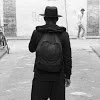
“LOG ON” - A Critical Reflection
LOG ON
Multimedia Film & Performance Installation
Log On is a multimedia film and performance project exploring the intersection of Black masculinity, queer identity and Grime culture. Through film, original music, dance, performance and montage, the work investigates how ideas of masculinity are constructed, performed and challenged within Black British culture.
The project draws inspiration from Isaac Julien’s Looking for Langston and Marlon Riggs’ Tongues Untied, two significant works associated with New Queer Cinema. Both films demonstrate what B. Ruby Rich characterised as the movement’s “fresh, stylistically daring, edgy, inventive, unapologetic” approach to filmmaking. More importantly, they created forms of Black queer expression that contributed to the wider cultural and political conversations of their time.
Taking inspiration from these works, Log On considers what a contemporary Black queer film might look and sound like when situated within the cultural landscape of East London and the generation shaped by Grime.
The project asks how the visual and sonic codes associated with Black masculinity might be disrupted, reclaimed and ultimately reimagined through queer experience.
Concept
At the centre of Log On is a dramatisation of life from the perspective of a 1990s-born, Class of ’07 Black gay man who grew up through Grime’s cultural influence while navigating the streets of East London.
Grime provides an important cultural backdrop because its influence extended far beyond music. It created its own visual language through fashion, music videos, dance, slang and representations of urban life. For a generation growing up in London during the 2000s, these codes became closely connected to particular ideas of Black British masculinity.
The project therefore uses my own relationship with Grime as a starting point for questioning masculinity.
What is masculinity? What does Black masculinity look like? What is femininity? Can femininity become an expression of masculinity? Does sexuality have a sound? Can music sound homophobic?
These questions form the creative foundation of the work.
Rather than attempting to provide definitive answers, Log On uses performance and moving image as spaces in which these contradictions can be explored.
Grime & Black Masculinity
Grime emerged from the social and cultural landscape of early-2000s London and became particularly influential within Black British youth culture. Alongside its music came a recognisable visual and physical aesthetic that frequently presented masculinity as intimidating, tough, emotionally guarded, heterosexual and hypermasculine.
These characteristics were communicated not only through lyrics, but through clothing, movement, music videos, performance and the physical behaviour associated with the culture.
During my research, I initially became interested in the relationship between Grime and homophobia. Several articles and texts connected the genre with homophobic attitudes, yet I struggled to locate the explicit homophobic language I expected to find within the music itself.
This led to a more interesting question:
What makes Grime feel homophobic if the homophobia is not always explicitly present within the lyrics?
My research began to suggest that the answer may exist within the wider performance of masculinity surrounding the genre.
The deep-rooted hypermasculinity associated with Grime, combined with particular representations of Black culture, can produce an environment that appears overtly heterosexual, un-effeminate and aggressive. This does not necessarily mean that Grime itself is inherently homophobic. Instead, it raises questions about how heteronormativity can become embedded within the visual and behavioural codes surrounding a cultural movement.
Jeffrey Boakye’s Hold Tight: Black Masculinity, Millennials and the Meaning of Grime became particularly important to this thinking. Boakye explores Grime as a subculture capable of providing a voice for marginalised Black communities while simultaneously producing an image of Blackness that can be consumed by the mainstream. Central to this image is a very particular representation of Black masculinity.
For a Black gay man who grew up within this culture, that relationship becomes complicated.
Grime could simultaneously provide a sense of cultural belonging while presenting forms of masculinity that appeared incompatible with openly queer expression.
Performing Masculinity
This research also encouraged me to question the extent to which Grime influenced my own performance of masculinity.
Did the excessive representation of the Black hypermasculine image allow me to adopt aspects of that persona? Did the aggressive sonic undertones of Grime, particularly in comparison with its predecessor UK Garage, affect the way I danced, dressed or carried myself?
Was I performing a character in order to exist comfortably within these environments, or had those behaviours become an authentic part of my identity?
These questions moved the project away from simply investigating Grime as a potentially homophobic space. Instead, I became interested in how queer people adapt to and exist within cultural environments structured around heterosexuality.
Grime allowed gay men like myself to experience Black hypermasculine homosociality from within. Rather than existing entirely outside these spaces, queer men could learn their codes, participate in them and sometimes adopt aspects of their masculinity.
The project therefore became increasingly interested in the possibility that masculinity is not fixed, but assembled through different cultural experiences.
New Queer Cinema & Montage
The filmmaking of Isaac Julien and Marlon Riggs provides an important visual and methodological influence for Log On.
Looking for Langston and Tongues Untied created representations of Black queer life through combinations of poetry, music, archival imagery, autobiography, performance and fictional reconstruction. Rather than presenting straightforward narratives, both filmmakers used these fragments to construct wider emotional and political meanings.
I wanted to adopt a similar approach while placing the work within a contemporary Black British context.
Montage therefore became central to my practice.
During the research process, I began considering how historical and contemporary images might be placed beside one another to create new meanings. Grime videos, Black Lives Matter footage, images of Black oppression, political events, popular culture and fragments from the history of queer cinema could exist alongside fictional scenes and autobiographical material.
The intention is not simply to reference these moments but to create relationships between them.
Through montage, Log On can move between the personal and political, past and present, masculine and feminine, reality and fiction.
Narrative Development
Running underneath the wider cultural themes of the film is an intimate love story set in London.
The narrative follows two Black gay men and a mannequin, using surreal and symbolic imagery to explore secrecy, intimacy, vulnerability and relationships.
The mannequin represents the presence of a third person within the relationship, while a cloud becomes a physical representation of love, passed between characters throughout the film.
The emotional structure of this story developed from my remix of Keri Hilson’s Tell Him the Truth. The original song explores the emotional consequences of keeping a secret from someone you love. I became interested in taking this narrative and repositioning it within a gay relationship.
Rather than creating a literal adaptation of the lyrics, the song becomes an emotional framework through which the characters navigate honesty, desire and vulnerability.
Like Looking for Langston, the intention is to allow the artistic narrative to exist within a much broader exploration of Black culture, sexuality and identity.
The love story gives the political questions within the film a human and intimate centre.
Music & Sound
Music became another method through which I could investigate masculinity.
During the research and development process, I created two pieces of music that represent different emotional territories within the project.
The first, Tom, was created using the stylistic characteristics of Grime. I wanted to use the aggressive sonic qualities associated with the genre to express my own frustrations surrounding oppression and homophobia experienced within Black culture.
However, rather than simply reproducing hypermasculinity, I became interested in what would happen when this sound was placed against imagery containing both masculine and feminine expression.
A hypermasculine sound could accompany a queer body.
The second experiment was my remix of Keri Hilson’s Tell Him the Truth. Where Tom explores aggression and masculinity, this track introduces vulnerability, secrecy and romance.
Together, the pieces began creating a tension between public masculinity and private vulnerability, which became increasingly important to the wider film.
Movement Research
Dance provided an opportunity to explore these ideas physically.
I began by looking at movements performed in response to Grime and other forms of urban music and questioning why particular gestures are immediately understood as masculine.
Rather than rejecting these movements, I experimented with combining them with movement that might traditionally be perceived as feminine.
The aim was to investigate whether a new movement language could emerge—one capable of containing Black masculinity and queer expression simultaneously.
An R&D workshop allowed me to begin testing these ideas with performers. Through the workshop, I became increasingly interested in the body as a site where supposedly contradictory identities could coexist.
Masculinity did not necessarily have to disappear for femininity to become visible.
Both could exist within the same body.
Queer Visibility
The project also developed alongside wider conversations surrounding Black queer visibility within popular culture.
Artists including Frank Ocean, Lil Nas X and Kevin Abstract have achieved significant mainstream success while challenging expectations surrounding Black masculinity and sexuality. Their careers raise questions about how and when queer Black expression becomes acceptable within mainstream culture.
Other artists, including UK performers Karnage Kills and Mr Strange, have positioned their sexuality at the forefront of their artistic identities from the beginning of their careers.
These different approaches raise important questions for my own practice.
How can an artist challenge heteronormativity without simply reproducing the structures they are attempting to resist? Does queer expression become more commercially acceptable when it conforms to recognisable forms of masculinity? And how can Black queer artists create work that remains culturally specific without becoming restricted by expectations of what Blackness or queerness should look like?
Rather than attempting to create a universally representative image of Black gay identity, Log On responds specifically to my own cultural experience as a Black gay man shaped by London, Grime and Black British culture.
Research & Development
The development of Log On took place during COVID-19 restrictions, which significantly affected the practical research process.
The movement workshop was conducted with actors rather than trained dancers and had to operate within limited rehearsal time. This affected how extensively I could develop the choreography and prevented me from fully experimenting with dance-for-camera.
Collaboration within the music production process was similarly affected. I had originally intended to work directly with musicians and artists in the studio, but restrictions made this difficult. I attempted to facilitate collaboration remotely by sharing music files with research participants, but limited responses eventually led me to produce the music independently.
Although these restrictions created challenges, they also changed my understanding of my own practice.
I realised that I had attempted to occupy too many creative roles simultaneously. Going forward, elements of production could be delegated to collaborators, allowing me to concentrate more clearly on the overall artistic direction of the work.
At the same time, the process demonstrated that I could independently produce film, sound and performance material when necessary.
Breakthrough
The most important development to emerge from Log On was a change in how I understood masculinity within my own practice.
At the beginning of the research, I was interested in using Grime as a way of expressing my own masculinity and Black identity.
As the work developed, I became less interested in reproducing an existing version of Black masculinity and more interested in creating my own.
Tony Coles’ concept of mosaic masculinities became useful here. Coles describes how individuals can draw upon fragments of hegemonic masculinity that they are capable of performing and combine them with other experiences to construct their own understanding of masculinity.
This offered a way of understanding what was happening within my creative practice.
I did not have to choose between masculinity and femininity, Blackness and queerness, Grime and queer culture.
Instead, these different cultural languages could be fragmented, combined and reconstructed.
My thinking therefore shifted from using Grime to express my own masculinity and Black identity towards creating a new artistic practice capable of embodying Black masculinity and queer expression visually.
This became the central breakthrough of the project.
Moving Forward
Log On ultimately became less about determining whether Grime itself is homophobic and more about understanding how masculinity is culturally produced, performed and negotiated.
The project uses Grime because it represents a cultural language that shaped my generation and my own relationship with Black masculinity. Rather than rejecting that history, I want to take its sounds, movements and aesthetics and place them into conversation with queer cinema, femininity, intimacy and vulnerability.
In this sense, the work follows the artistic lineage established by Tongues Untied and Looking for Langston. Both films created Black queer expression that responded directly to their cultural moment while contributing something new to the representation of Black queer life.
Log On attempts to continue that conversation from the perspective of a Black gay man shaped by twenty-first-century East London.
Through film, sound, dance and montage, I want to create work that does not simply ask whether Black masculinity can accommodate queerness.
I want to explore what Black masculinity can become when queerness is already understood as part of it.
Selected Bibliography
Aaron, M. (2004). New Queer Cinema. Edinburgh: Edinburgh University Press.
Boakye, J. (2017). Hold Tight: Black Masculinity, Millennials and the Meaning of Grime. London: Influx Press.
Boakye, J. (2019). Black, Listed: Black British Culture Explored. London: Dialogue Books.
Bramwell, R. (2015). UK Hip-Hop, Grime and the City: The Aesthetics and Ethics of London’s Rap Scenes. New York: Taylor & Francis Group.
Coles, T. (2008). “Finding Space in the Field of Masculinity: Lived Experience of Men’s Masculinities.” Journal of Sociology, 44(3), 233–248.
Gunter, A. (2010). Growing Up Bad? Black Youth, ‘Road’ Culture and Badness in an East London Neighbourhood. London: Tufnell Press.
Haywood, C. et al. (2018). The Conundrum of Masculinity: Hegemony, Homosociality, Homophobia and Heteronormativity. New York: Routledge.
2021
Film, sound, dance, performance, research & montage