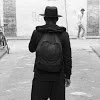
“LOG ON” - Production / Practice Portfolio
Immersive Theatre: Developing Log On
Introduction
Log On developed from an exploration of immersive theatre, audience participation, Black masculinity and queer expression. The work began with a relatively simple question: how can an audience become immersed in a performance rather than simply watch it?
As the project developed, that question became much broader. I became interested in what happens when the audience is not only physically present within a performance space, but becomes part of the work itself. I began thinking about participation, social media, the body, projection, surveillance and the ways in which Black masculinity and queer identity are seen, interpreted and performed.
The final work became a combination of projected film, live performance, silhouette, sound and physical space. Although the project began as an exploration of immersive theatre, it gradually developed into something closer to an installation, deliberately blurring the boundaries between film, performance and audience experience.
Finding Immersion
At the beginning of the project, I looked at two pieces of work: Still Here by Access All Areas Theatre and Perfect Instaby Coney.
What interested me about Still Here was the way the audience could become lost within the storytelling. The work placed the audience within a real environment while combining movement, poetry and soundtrack. Rather than simply observing a story, the act of moving through the space became part of experiencing it.
Perfect Insta approached participation differently. The audience was required to do something themselves. The act of taking a photograph became part of the work, with the audience simultaneously becoming both consumer and producer.
These ideas led me towards the concept of the prosumer: someone who both consumes and produces an experience.
I began asking myself:
How can I create an immersive experience within a theatre setting?
And:
How can I engage the audience through participation rather than simply asking them to watch?
I started to distinguish between immersion and participation. Participation is about doing, controlling or contributing to what is happening. Immersion is about becoming lost within a space, atmosphere or moment.
This distinction became important to the development of the work. I wanted the audience to feel that they had entered a world, but I also wanted their presence and actions to have the potential to affect that world.
From Immersive Theatre to Installation
My initial idea was to create an immersive theatre experience in which the audience would move around a space while watching projected film and interacting with the work through social media.
One of my early ideas was called “Guilty by Association.”
The concept involved audiences submitting words, reactions, hashtags or comments through social media. These could then become part of the projected environment. The words would accumulate around the performance, creating a visual representation of the audience's responses.
I was particularly interested in this in relation to stereotypes surrounding Black men.
The audience could contribute to the experience without necessarily feeling as though they were completing a formal task. Social media had already made this kind of behaviour normal: taking photographs, posting reactions, commenting and sharing.
I also considered using audience-generated photographs and videos within the installation. If the work were presented on a loop, each audience could potentially change what the next audience encountered.
The performance would therefore never be completely identical.
This was where the concept of the prosumer became particularly useful. The audience would not simply consume the work; they would contribute to its production.
However, the practical limitations of the space eventually meant that I had to scale this idea back. After discussing the project with the technical team, I realised that some of the elements I had imagined were not possible within the available space and resources.
Rather than seeing this as a failure, I used the limitations to reconsider what the work actually needed.
The project became smaller, more focused and more visual.
The Body, Surveillance and the Gaze
I wanted the introduction to the work to immediately establish an atmosphere.
One of the earliest visual ideas was a CCTV-style image of myself filmed from behind and from a slightly elevated angle.
The image was partly influenced by ideas around voyeurism and psychoanalysis, but it was also connected to the stereotypes imposed upon young Black men.
The image of the Black male body is rarely neutral.
It can be read through assumptions about criminality, aggression, sexuality, masculinity and danger before the individual has even been encountered.
I wanted to play with that act of looking.
The audience would be watching me, but I also wanted the work to make them conscious of how they were watching.
This led me towards the work of Edward Said and Laura Mulvey, particularly ideas around othering and the male gaze.
Said's discussion of the construction of the “Other” helped me think about how cultural hierarchies create binaries between what is considered normal and what is considered different.
Mulvey's writing around the male gaze, meanwhile, made me consider the relationship between looking, objectification and power.
I began asking:
What happens when the Black male body becomes the object of the gaze?
And:
What happens when that body is simultaneously masculine, queer, vulnerable and sexual?
These questions became central to the visual language of the piece.
Looking for Langston
Isaac Julien's Looking for Langston became an important reference point for the project.
What interested me was not simply the film's representation of Black queer desire, but its ability to challenge established ways of seeing Black masculinity.
I became particularly interested in the idea of “queering the gaze.”
Rather than accepting the visual codes through which Black masculinity has traditionally been represented, I wanted to manipulate, reframe and disrupt those codes.
My work therefore became a conversation between archival imagery, my own body, projected film and live performance.
I wanted to create something that felt dreamlike and fragmented rather than entirely literal.
The intention was not to reproduce Looking for Langston, but to take elements that resonated with me and place them within my own experience and artistic language.
The working title was initially Looking for LXVI, but I eventually changed it to Log On. The new title felt broader and more connected to the ideas of looking, surveillance, social media, participation and entering a digital or physical space.
Black Masculinity and Queer Expression
A major part of the project was my relationship with Black masculinity.
Growing up with grime and UK urban music culture, I became interested in the way masculinity is performed through music, movement, clothing, gesture and social interaction.
The body language associated with grime can communicate strength, aggression and confidence. But these same codes can also become restrictive when they are connected to homophobia or rigid ideas about what a man should be.
I wanted to explore this contradiction.
The performance uses movement associated with grime and Black music culture, but places those movements within a queer context.
The intention was not to reject those movements or the culture from which they came. Instead, I wanted to explore what happens when those codes are inhabited by a Black queer body.
This became connected to José Esteban Muñoz's concept of disidentification.
Disidentification provided a useful way of thinking about how minority subjects can negotiate dominant cultural codes without simply accepting or rejecting them.
For me, this meant taking familiar representations of Black masculinity and transforming them from within.
I could perform masculinity while simultaneously questioning what masculinity was supposed to look like.
I could be aggressive and soft.
Masculine and feminine.
Visible and hidden.
Familiar and ambiguous.
These contradictions became part of the performance language.
The Vulnerable Observer
Ruth Behar's The Vulnerable Observer also influenced the way I thought about my position within the work.
The more personal the project became, the more I had to consider what it meant to use my own experiences as material.
There is vulnerability in making work about your own identity.
The work can never represent every Black queer experience, because my experience is my own.
This became particularly important when thinking about representation.
I did not want to create a work that suggested there was one universal Black or queer experience. Instead, I wanted to create something rooted in my own perspective while allowing other people to find their own points of connection within it.
This also made me think about how work by Black and queer artists is often positioned by institutions and audiences.
There can be a tendency to categorise work according to the identity of the artist before engaging with the work itself.
I wanted Log On to be Black and queer without being reduced to being “Black queer art.”
I wanted it to be personal without becoming inaccessible.
I wanted it to communicate something specific while leaving space for different interpretations.
Negotiating the Border
Gloria Anzaldúa's Borderlands helped me think about this tension further.
The idea of borders became a useful metaphor for thinking about identity, culture and belonging.
There are physical borders, cultural borders and social borders. There are also invisible boundaries around what we are expected to be.
For me, being between different cultural, social and artistic spaces has always influenced how I understand identity.
I became interested in what happens when you cross those boundaries rather than remain neatly within them.
Log On therefore became an attempt to exist between categories:
Between film and theatre.
Between installation and performance.
Between masculinity and femininity.
Between mainstream and underground culture.
Between spectator and participant.
Between Black cultural expression and queer expression.
The work did not need to resolve these contradictions.
It needed to sit within them.
Making the Work
The production process was highly experimental.
I entered the initial performance sharing with a general idea rather than a completed film. I deliberately wanted to understand what was possible within the space before committing to the final production.
This proved important because several elements of my original plan were not technically possible.
The second projector I had planned to use was not powerful enough for the space, and I could not create the raised platform I had originally imagined for the audience.
There were also questions around the silhouette and whether it had a clear enough purpose.
As a result, I scaled the performance back.
The silhouette became integrated with the projected film, appearing in both the recorded and live environments. Props were illuminated at particular moments to create transitions between what the audience saw on screen and what they experienced in the physical space.
Rather than trying to force the original concept into the space, I allowed the limitations of the space to reshape the work.
Filming
The filming process was equally experimental.
I did not have every shot planned in advance. Instead, I knew the visual language I wanted to explore and used the filming sessions to discover what worked.
The first filming day involved a lot of trial and error.
Some of the strongest footage came from moments that were not necessarily planned. Working under pressure also forced me to make quicker creative decisions and become more selective about what belonged in the final piece.
The second filming day changed the direction of the work further.
One of the performers cancelled, leaving me to work with a single performer. Unexpectedly, this created an opportunity.
The story became less literal.
Instead of presenting a straightforward gay love story, I began experimenting with ambiguity.
The figures did not necessarily need to represent specific characters.
They could represent bodies, relationships, identities or possibilities.
This ambiguity became increasingly important.
I wanted the audience to question what they were seeing rather than immediately being given an answer.
Gesture and Homosociality
One of the recurring visual elements was the use of familiar greetings and gestures within Black culture.
These gestures became a way of exploring homosociality.
Within UK Black music culture, particularly around grime and other urban genres, masculinity is often communicated through physical interaction, posture and movement.
I wanted to reproduce some of these gestures but place them within a different context.
The same gesture could communicate friendship, masculinity, intimacy or even tension depending on how it was presented.
This became another way of questioning the boundaries between masculinity and queerness.
The movement itself does not necessarily belong to one identity.
Its meaning can change depending on who performs it, where it is performed and who is watching.
Ambiguity, Objects and the Body
As the filming progressed, I became increasingly interested in ambiguity.
I experimented with props, projections and silhouettes rather than relying solely on the body itself to communicate meaning.
I also began exploring phallic imagery.
Earlier in my practice I had used nudity as a powerful visual device, particularly through the juxtaposition of a vulnerable Black male body with the masculine visual language of the urban environment.
For Log On, I did not want to simply repeat that approach.
Instead, I wanted to suggest sexuality rather than make it explicit.
The silhouette became particularly useful for this.
It allowed the body to be present while remaining partially hidden.
The audience could recognise a body without necessarily being given complete access to it.
This became connected to ideas around racial fetishism and the historical reduction of Black male bodies to sexuality.
Rather than showing the body completely, I used fragmentation, shadow, movement and projection.
The body became something to interpret.
Filming Myself
One of the later stages involved filming myself.
I experimented with showing my face and concealing it. I questioned whether I wanted to be recognisable within the film or whether my presence should remain ambiguous.
I also spent considerable time developing the silhouette.
The silhouette needed to work in the film but also be reproducible within the live performance.
This created technical challenges.
Because I was filming myself, the camera would sometimes become visible or the silhouette would become unclear. This meant repeatedly repositioning myself and starting again.
Although the process was time-consuming, the experimentation was worthwhile.
The silhouette eventually became one of the strongest visual devices within the work.
It allowed me to explore the body without relying on conventional representation.
Sound, Editing and Movement
I edited the film using Adobe Premiere Pro.
The editing process was guided by the relationship between movement, sound and imagery.
I wanted the opening to draw from the aggressive physicality associated with grime before gradually introducing more fluid and feminine movement.
This contrast reflected the wider research underpinning the project.
The soundtrack had an aggressive but suspenseful quality, particularly towards its ending. I wanted to work with that tension while introducing imagery influenced by New Queer Cinema and my own interpretation of Black masculinity.
The final film therefore became less about telling a straightforward narrative and more about creating an atmosphere.
Movement, sound, shadow, projection and fragmented imagery work together to create a particular emotional experience.
Creating the Introduction
I also created a separate introduction for the work.
I wanted the audience to feel that something was already happening before the main performance began.
This was influenced by my background in events and nightlife.
I have always been interested in how an audience can be prepared for an experience before the main event actually begins.
The introduction was therefore not simply an explanation of the performance.
It was part of the atmosphere.
It was intended to shift the audience's attention away from their everyday environment and towards the world of the work.
From Research to Practice
The theoretical research ultimately became a way of making decisions rather than something separate from the creative process.
Said helped me think about othering.
Mulvey helped me question the gaze.
Behar helped me consider vulnerability and autobiography.
Anzaldúa helped me think about borders and cultural belonging.
Muñoz helped me understand disidentification.
Amideo's writing on Isaac Julien helped me consider how Black masculinity could be visually reframed.
These ideas became embedded within the work through imagery, movement, projection and performance.
Rather than illustrating theory, I wanted to make through theory.
The research became something I could test physically.
What happens when a Black male body is placed under surveillance?
What happens when masculine movement is performed by a queer body?
What happens when the body is fragmented, hidden or projected?
What happens when the audience is made conscious of their own act of looking?
These questions became more important than finding definitive answers.
What Log On Became
When I first began the project, I imagined creating an immersive theatre experience with a highly participatory audience.
The final work was much more contained.
But that does not mean the original idea disappeared.
Instead, the project moved from immersive theatre towards an immersive visual experience.
The audience might not physically control the entire performance, but they are still implicated through the act of looking.
They encounter the Black male body through surveillance, projection, silhouette and fragmentation.
They are asked to negotiate ambiguity.
They are asked to consider what they expect masculinity to look like.
And, ultimately, they are asked to consider how they look.
For me, this became the central idea of Log On.
The work is not simply about Black masculinity.
It is not simply about queerness.
It is not simply about grime, film, theatre or installation.
It is about what happens when these things meet.
It is about the possibility of taking familiar cultural codes and transforming them.
It is about occupying the space between identities rather than feeling compelled to choose one.
And it is about creating an image of Black queer expression that is not defined solely by oppression, sexuality or representation, but by creativity, ambiguity, movement and agency.
Ultimately, Log On became an attempt to create work that could be personal without being exclusive, political without becoming didactic, and visually challenging without relying on shock for its own sake.
I wanted to make something that could be understood from different perspectives while remaining rooted in my own experience.
Something Black.
Something queer.
Something masculine and feminine.
Something familiar and unfamiliar.
Something to watch — but also something to question. - Check out the “LOG ON” visuals below
References
Access All Areas Theatre (2020), Still Here.
Alston, A. (2016), ‘The Promise of Experience: Immersive Theatre in the Experience Economy’, in J. Frieze (ed.), Reframing Immersive Theatre: The Politics and Pragmatics of Participatory Performance. Liverpool: Palgrave Macmillan.
Amideo, E. (2017), ‘Undoing Black Masculinity: Isaac Julien's Alternative Grammar of Visual Representation’, in Queering Masculinities in Language and Culture. London: Palgrave.
Anzaldúa, G. (1987), Borderlands/La Frontera: The New Mestiza. San Francisco: Aunt Lute Books.
Behar, R. (1996), The Vulnerable Observer. Boston: Beacon Press.
Boakye, J. (2017), Hold Tight: Black Masculinity, Millennials and the Meaning of Grime. London: Influx Press.
Coney (2019), Perfect Insta.
Gómez-Peña, G. (2001), ‘The New Global Culture: Somewhere Between Corporate Multiculturalism and the Mainstream Bizarre’, TDR/The Drama Review, pp. 7–30.
Harvie, J. (2013), Fair Play: Art, Performance and Neoliberalism. London: Palgrave Macmillan.
Haywood, C. et al. (2018), The Conundrum of Masculinity: Hegemony, Homosociality, Homophobia and Heteronormativity. New York: Routledge.
Mercer, K. (1999), ‘Reading Racial Fetishism: The Photographs of Robert Mapplethorpe’, in Visual Culture: The Reader. London: SAGE.
Mulvey, L. (2014), ‘Visual Pleasure and Narrative Cinema’ (1975), in Film Manifestos and Global Cinema Cultures. Berkeley: University of California Press.
Muñoz, J. E. (1999), Disidentifications: Queers of Color and the Performance of Politics. Minneapolis/London: University of Minnesota Press.
Said, E. (2018), ‘Introduction’ from Orientalism, in Classic Readings from Monster Theory. Amsterdam: Amsterdam University Press.
Turner, C. (2004), ‘Palimpsest or Potential Space? Finding a Vocabulary for Site-Specific Performance’, New Theatre Quarterly, November, pp. 373–390.